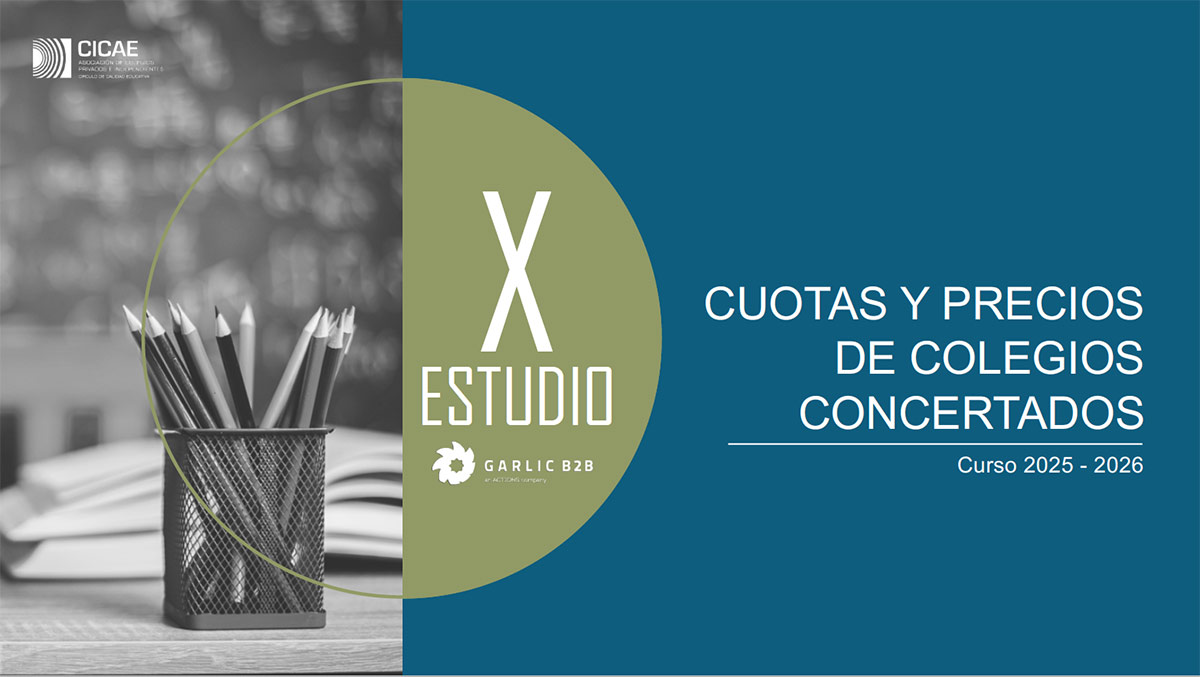
The Regional Federation of Associations of Parents of Students Francisco Giner de los Ríos(FAPA) and the Association of Private and Independent Schools – CICAE have presented an extension of the VII Study of Fees and Prices of Subsidized Schools, referring to data from the Community of Madrid for the academic year 2022-2023. The study concludes that 100% of the schools charge a fixed monthly base fee to the families in the compulsory stages and that its payment is compulsory in 82%, contrary to the free education in centers supported with public funds, protected by the Organic Law of the Right to Education.
The research has been carried out through the mystery shopper methodology , simulating families requesting information for the enrollment of their children in 115 schools in Madrid. Amparo Núñez, project manager of the consultancy firm in charge of the work, Garlic B2B, stated that “a lack of transparency in the communication offered to parents was detected, 30% do not provide price sheets and some of the centers do not provide documentation with this information despite numerous requests”.
The tendency in the Community of Madrid is for subsidized schools to increase the price of tuition every year, with the monthly average being 119.5 euros andmore than 150 eurosin 53% of the centers. Families have to make an average outlay of more than 3,000 euros per year, taking into account the rest of the school’s services.
For the first time, the results were analyzed according to the ownership of the subsidized center. Those that belong to commercial companies (limited and limited liability companies) charge an average monthly fee that is more than double that of congregations and religious institutions. For Elena Cid, general director of CICAE, this data shows that “the new subsidized education system that has proliferated in recent years, which does not depend on charitable and non-profit organizations, is the one that charges the most and puts the most pressure on families. We have normalized that parents have to pay fees for the profit of commercial entities for a basic and subsidized service such as education in schools supported with public funds”.
The president of FAPA, María Carmen Morillas, has highlighted the helplessness in which families find themselves. For this reason, they have launched a channel open to families so that “they can share their case with the Federation, confidentially if they wish, in order to advise them and inform the Public Administrations of these cases. We come across families who suffer the exclusion of their sons and daughters when they refuse to pay the fees”.
The board of CICAE has explained that the Madrid Administration is aware of this situation, since “it is the Ministry of Education itself who authorizes the fees, through a process that gives legal character to the co-payment of education in these schools, thus leaving families unprotected”. He has criticized the timing of this process, the poor documentation provided by the centers and “that they are allowed to charge high fees, with obvious profit, for curricular activities within school hours, making it clear that the freedom of choice of a charter school is subject to the economic capacity of families”.
María Carmen Morillas has made a statement on the transfer of public land from the Community of Madrid for the construction of charter schools, the calls for which were made public on November 10. She has stated that “the educational community has requested over time the construction of public schools in these areas without any reaction from the regional administration. In Valdebebas there is no public secondary school and the students have to go to school outside their neighborhood. Surprisingly, years later, the response of the Regional Ministry has been to announce the transfer of plots in Valdebebas and Villa de Vallecas for the construction of subsidized private centers at zero cost”. For the president, “the purpose of the educational agreement has been perverted, to the point of naming a center that does not yet exist as already subsidized. It is incomprehensible that in areas of new residential expansion the only educational option is private subsidized education, breaking the freedom of educational choice, which is for those who can pay because, in most cases and, as stated in the report, the subsidized education is paid”.